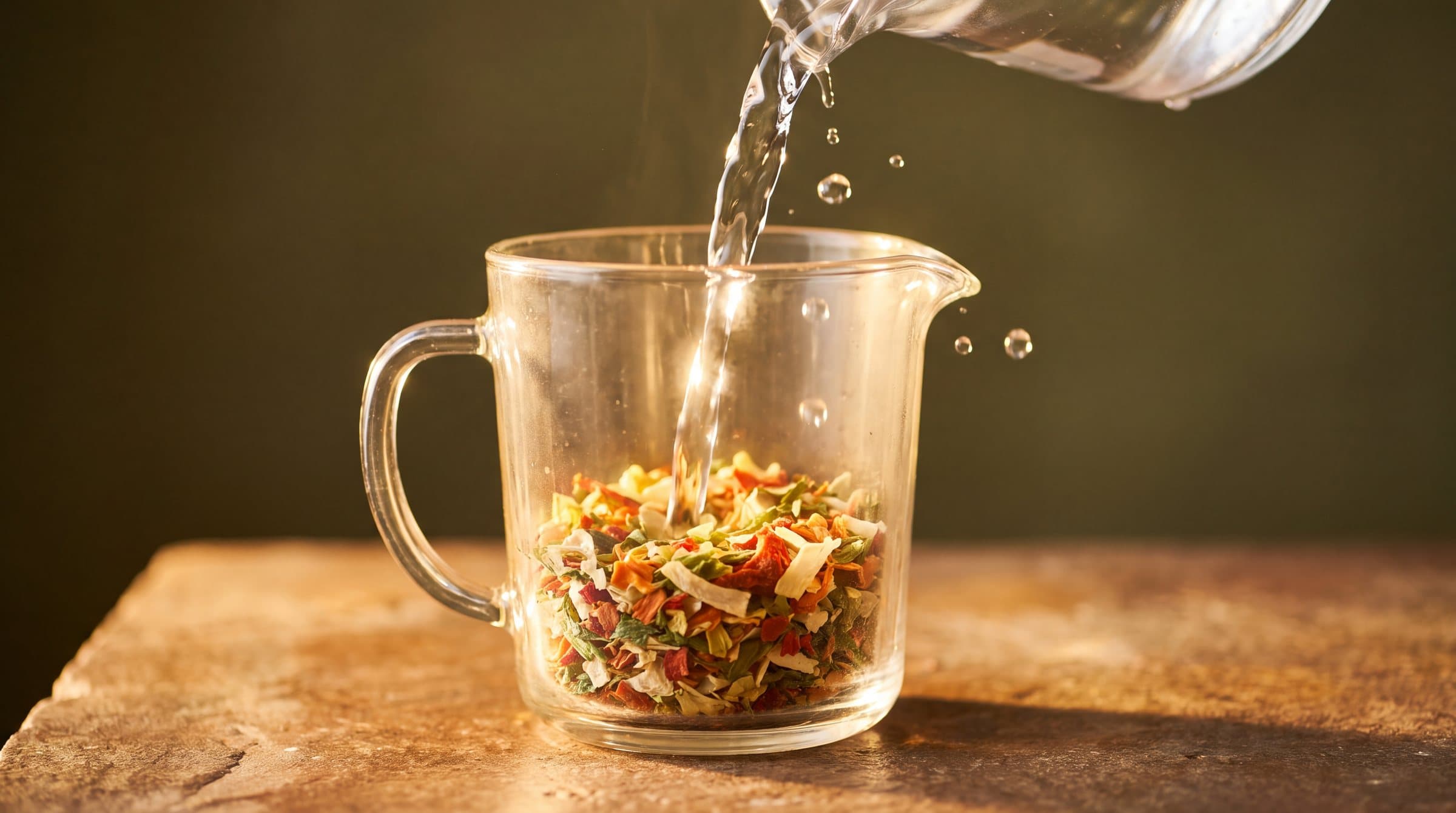
How to use it
Three ways, and the sum you actually need.
A hundred grams of dried vegetables wants two hundred and fifty to three hundred millilitres of water. What happens after that is up to how much time you have.
(01)Rehydrating
Pick the one that fits your evening.
Cold water
Pour 250 to 300 ml of cold water into a bowl, add 100 g of dehydrated vegetables and leave them for thirty minutes. Drain off what is left and cook as you normally would.
Boiling water
Pour 250 to 300 ml of boiling water over 100 g and leave it for ten to fifteen minutes. Drain and cook as normal. Same result, a third of the wait.
Straight in
Add the dehydrated vegetables directly to boiling water or to a stew and cook as normal. Season at the end rather than the start.
(02)Working out quantities
Feeding fifty? Here is exactly what to order.
Dried mass and cooked mass are not the same number, which makes ordering for a crowd a guess unless somebody does the arithmetic. This does it. The yield factors are ours and they are measured, not estimated.
How much do I order?
Our own yield figures, doing the sum for you.
Costed at 80 g a portion.
You need to order
656 g
of dried green beans
- Portions
- 50 × 80 g
- Cooked yield needed
- 4.0 kg
- Yield factor
- ÷ 6.1
- Dry mass
- 656 g
(03)The full table
Yields, vegetable by vegetable.
How much fresh produce goes into a kilogram of dry, and how much cooked food comes back out of it.
| Vegetable | Cut | Fresh kg per 1 kg dry | Cooked from 1 kg dry | Factor |
|---|---|---|---|---|
| Cabbage | Shredded | 20 | 7 300 g | 7.3 |
| Carrots | Flakes | 15 | 5 900 g | 5.9 |
| Garlic | — | 4 | 1 900 g | 1.9 |
| Green beans | — | 14 | 6 100 g | 6.1 |
| Leeks | — | 10 | 4 500 g | 4.5 |
| Mixed vegetables | Diet | — | 5 200 g | 5.2 |
| Mixed vegetables | Macedoine | — | 5 300 g | 5.3 |
| Onions | — | 9 | 4 900 g | 4.9 |
| Parsley | — | 15 | 10 000 g | 10 |
| Peas | — | 7 | 3 400 g | 3.4 |
| Potatoes | Strips | 7 | 4 500 g | 4.5 |
| Reddi beans | — | 1.2 | 2 900 g | 2.9 |
| Spinach | — | 16 | 5 200 g | 5.2 |
| Sweet potatoes | Strips | 6 | 3 600 g | 3.6 |
| Tomatoes | Flakes | 26 | 10 000 g | 10 |
| Tomato whirls | — | — | 2 500 g | 2.5 |
Between 92% and 95% of the moisture is removed and very little of the nutrition goes with it. Colour holds because the vegetables are blanched before drying, which stops the enzyme action that would otherwise dull them.
Keeping it
Four rules, and the shelf life looks after itself.
Cool and dry
A cupboard is right. A sunny windowsill is not.
Out of the sunlight
Light can shift the colour of a powder. Cooking brings it back, but there is no reason to let it happen.
Reseal it
Most of this is hygroscopic, which means it pulls moisture out of the air. Close the bag and it keeps.
Once it is open, use it
A tin is sized for about four people and is meant to be finished.
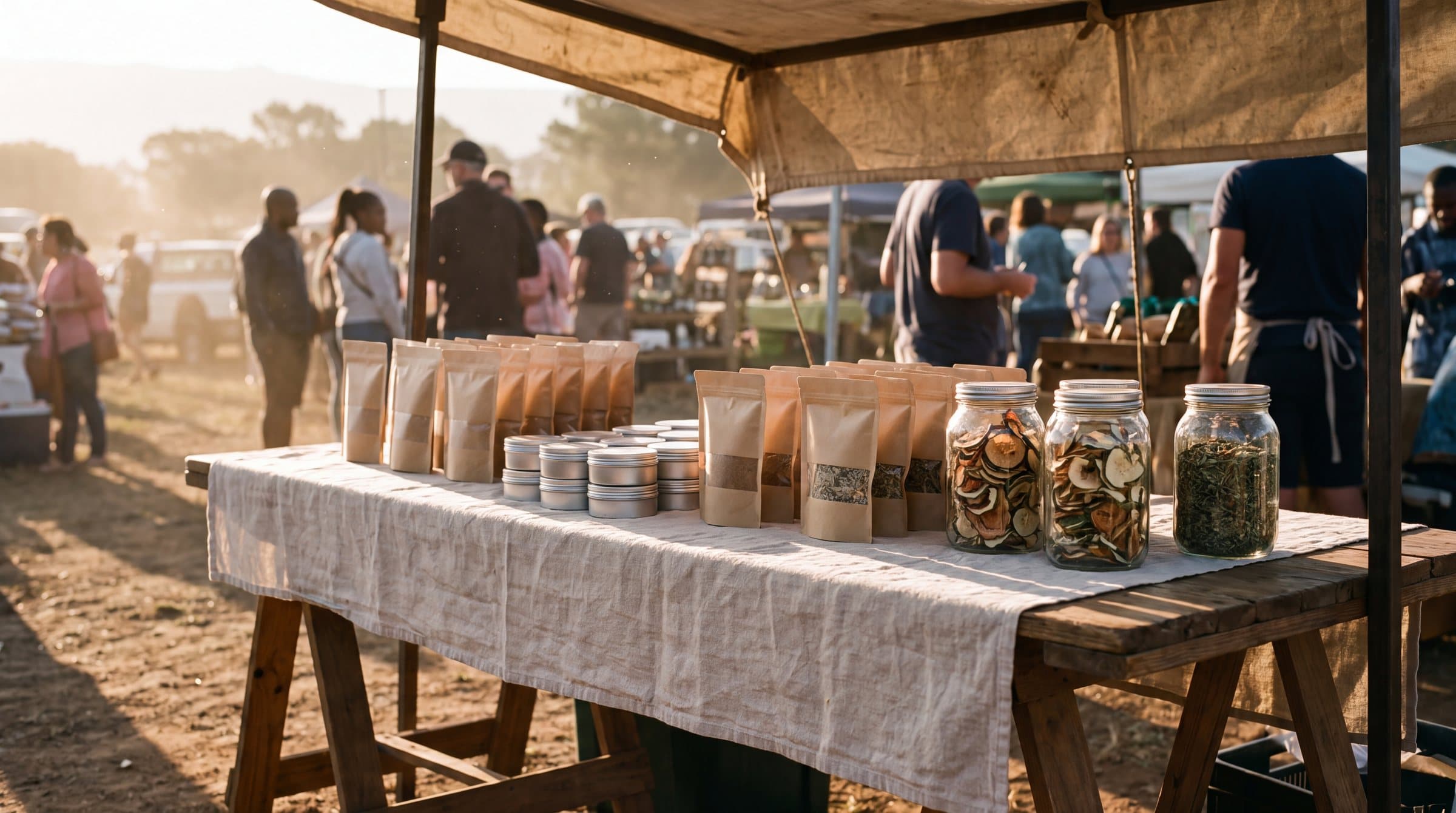
Put a hundred grams in water and see for yourself.
Send us a message and we will tell you what we have, what it costs, and when we are next at a market near you.